My personal introduction to providing telehealth services
A few months ago, I began working for a veterinary telehealth service. I’ll admit, I had some reservations at first—both about how the model would function and whether I could still provide the standard of care I expect of myself. My boss reassured me that most cases were straightforward and could be effectively managed through remote access. I was never expected to prescribe medications or make clinical decisions that fell outside my comfort zone.
That being said, my third patient was a 4‑month‑old Doodle in lateral recumbency—lying on his side, depressed, and completely unresponsive. His young owner had scraped together money she didn’t have, desperate to get help for her seriously ill pup. My first question focused on his vaccination history.
“The breeder said he had been vaccinated, but I haven’t received any paperwork.”
“And how long have you had him?”
“One month.”
“And have you given him any vaccinations?”
“No.”
This poor pup was likely dying of either parvovirus or distemper. He was vomiting and severely dehydrated. I struggled with how to manage this virtual visit. I immediately emphasized the need for him to be seen at an emergency center, even as I knew his owner had absolutely no financial means to make that happen. In the end, I prescribed a medication to ease his nausea, hoping it would at least make him a bit more comfortable. It was an incredibly difficult call.
What are the barriers to veterinary telehealth?
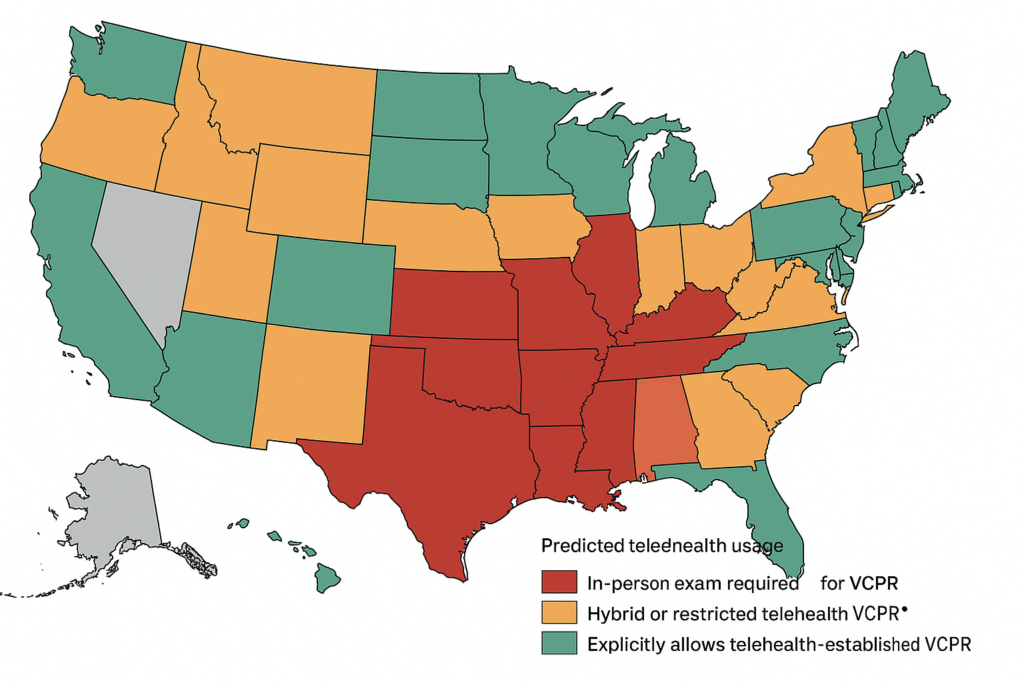
By far the biggest hurdle facing veterinary telehealth is legality, which varies widely from state to state. At the center of the issue is the establishment of a Veterinary Client Patient Relationship (VCPR). Increasingly, states are allowing a VCPR to be established through virtual means alone. Others still require that the relationship be created in person before telehealth services can be used.
I recently received an email from the American Veterinary Medical Association (AVMA) outlining their opposition to establishing a VCPR through virtual means. While they acknowledged that each state has the authority to set its own requirements, the AVMA made it clear that they do not support creating a VCPR solely via telehealth.
I became aware of a recent interview with the founder of a company that competes with my employer. Honestly, I wasn’t impressed with either the interviewer or the interviewee. By the end of the discussion, the founder was claiming there was a conspiracy underway to limit access to veterinary care and drive prices sky‑high. The host was more than willing to climb aboard the conspiracy wagon. The implication was clear: the AVMA was supposedly behind it.
I have never been a conspiracy theorist, nor do I believe that most institutions or organizations are inherently nefarious. However, I’ve increasingly come to recognize how profoundly financial interests shape decision‑making, and the AVMA is no exception. I do think part of the hesitation around expanding telehealth access stems from a fear that it could negatively impact brick‑and‑mortar practices.
Veterinarians are concerned that telehealth will replace in‑clinic revenue. Many don’t know how to bill for virtual services, and they don’t have time to integrate new systems into their already packed schedules. Most lack staff trained in virtual triage, and they also worry about potential liability issues.
Other barriers to telehealth include technology requirements and user experience. I’ve had clients participating in their very first Zoom meeting. Rural areas—those that could benefit most from telehealth—are often the same places with the slowest internet access. Poor‑quality video makes it much harder to assess a wound or an irritated ear.
Lastly, lack of awareness and cost concerns can also limit the effective use of veterinary telehealth. Many clients don’t know when a virtual visit is appropriate, and they may be reluctant to pay for what they fear will amount to “just advice.” They also may not know how to identify the best telehealth company or program.
Who is currently using veterinary telehealth?
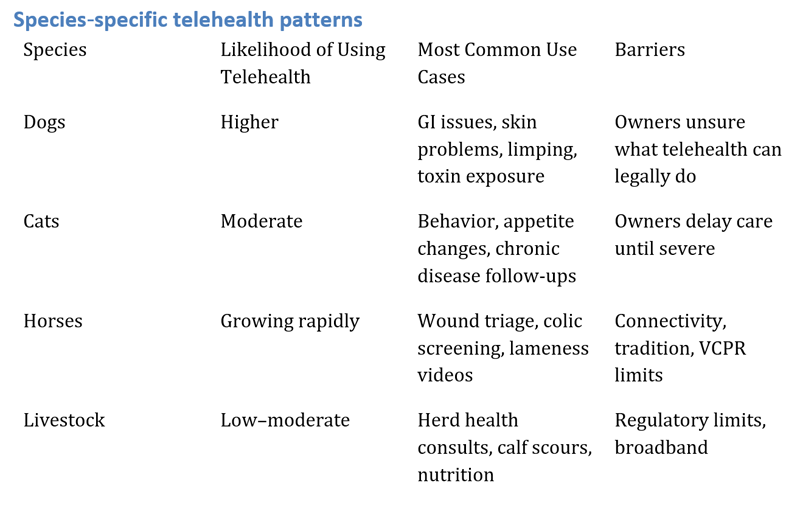
This AI-generated chart provides some insight into how veterinary telehealth is currently being used.
Over the past several months, the majority of my telehealth cases have involved conditions that are both common and highly amenable to remote assessment: skin issues, ear problems, urinary tract concerns, and gastrointestinal upset. I also frequently work with clients who have recently moved and have not yet established care at a brick‑and‑mortar clinic but need a refill for a previously diagnosed, well‑managed condition.
While there are certainly moments when I would prefer to place my hands on a patient, the lack of physical contact rarely limits my ability to diagnose and manage these routine issues effectively. For the most common presentations, telehealth provides sufficient information to guide appropriate care, maintain continuity, and support both the animal and the owner without compromising safety or quality.
Does YOUR state offer veterinary telehealth?
I live in Arizona, one of the first states to approve a virtual VCPR. While we live in the literal desert, we also face a veterinary desert — especially when it comes to timely, affordable access to care. I don’t like treating my own animals, particularly my horses, since I never practiced equine medicine. But even as a veterinarian, I can’t get the local equine vet to return my calls.
Clients routinely tell me it takes up to three weeks to get a clinic appointment. As the Veterinary Resource Coordinator for Arizona Border Collie Rescue, I work with numerous clinics across Phoenix and its surrounding suburbs. I’ve seen firsthand how difficult it can be to get a dog seen promptly — even for urgent but treatable conditions.
Arizona’s telehealth-friendly stance is not just progressive — it’s essential. In a state where vast geography and veterinary provider shortages collide, remote care is often the only timely option. Without it, animals wait — and sometimes suffer — while owners scramble for access.
Since launching my telehealth services, I’ve expanded my licensure to Idaho and New Jersey — two states where remote care can help bridge similar gaps. Vermont is currently evaluating its approach to telehealth, and Texas continues to struggle with regulatory clarity. These differences matter. They shape whether a dog with an ear infection gets seen today or waits weeks. They determine if an owner has to drive miles to get a prescription for a flea product or a refill on their old dog’s incontinence medication.
In summary…
National estimates suggest that 10–20% of U.S. pet owners have used veterinary telehealth. In states with VCPR‑friendly regulations, that number climbs to 20–30%. Dog owners tend to be at the higher end of the range, while cat owners are somewhat lower — consistent with the fact that dog owners generally seek care more frequently overall. Telehealth use for equine issues is estimated at roughly 15%, and it is rising quickly as access challenges worsen in rural areas.
If I knew anything about chickens, I could probably add poultry telehealth to my current workload… but I don’t! What these numbers show, though, is that telehealth is no longer experimental. It’s a tool that owners are already using, especially when geography, cost, or clinic availability make traditional care difficult to access.
When I wrote When to Call the Vet for Your Horse, I talked about the rise of “Dr. Google” — that instinct we all have to search the internet the moment something looks off. With the explosion of online information, and now the addition of AI tools, it has never been easier for owners to research symptoms or compare their animal’s situation to something they’ve read online.
People who are already comfortable navigating the web tend to be the same individuals who embrace telehealth. They’re used to gathering information digitally, asking questions online, and seeking quick, accessible guidance. Telehealth feels like a natural extension of that behavior.
But convenience doesn’t replace expertise. Even in a world overflowing with information, it remains essential that diagnoses and treatment decisions come from trained professionals who understand context, nuance, and the difference between a common issue and a true emergency. Online resources can help owners recognize when something might be wrong — but they can’t replace the judgment, experience, and accountability that come with professional veterinary care.
There is much more to tell you about my personal experience with veterinary telehealth, so watch for a Part Two on this topic!