My Facebook page has been blowing up with questions about the New World screwworm and its impact on travel with both large and small animals. There are several reasons why I’m being inundated with questions and concerns.
As a USDA-accredited veterinarian, I help monitor and control this parasite. I also live in southeastern Arizona, where active infestations are currently being reported all around me. While my area is not yet considered an active infestation zone, it is likely only a matter of time before that changes.
One of my longstanding strengths has been educating clients and helping them develop sound animal husbandry practices. We have to know better to do better.
In my effort to better understand this outbreak and provide accurate information, I completed a USDA training module on the New World screwworm. Throughout this series, I’ll be sharing several slides from that training and giving full credit to the USDA for the information presented.
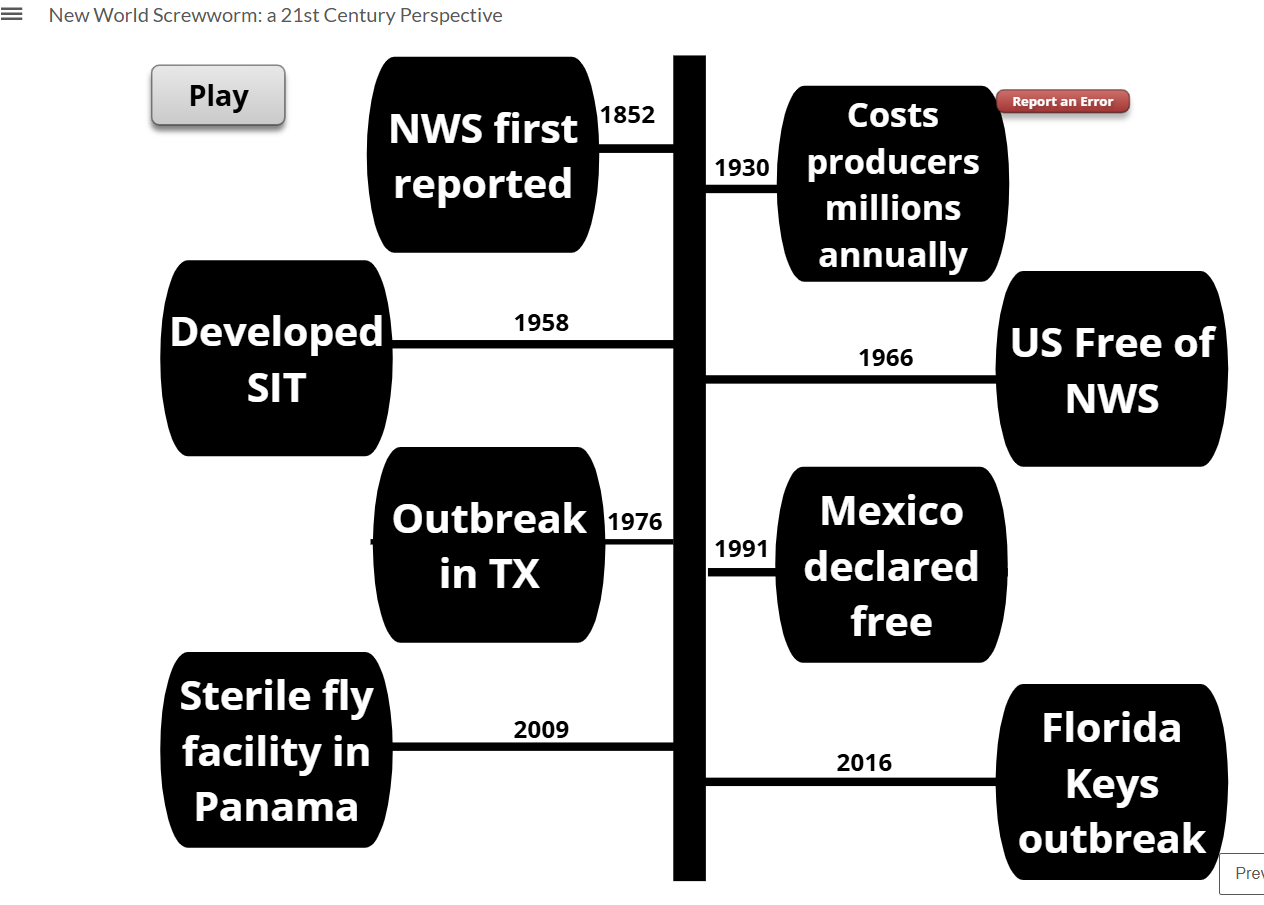
The history of New World screwworm
I am fielding questions from people who are interested in knowing how New World screwworm affects them now. There is less interest in understanding the history of this fly. Nevertheless, it helps to realize how long this has been an issue, and how much effort and money have been devoted to treating the infected animals and eradicating the disease.
In southwest Texas during the 1950s, a New World screwworm outbreak affected not only the cattle industry but also wildlife populations. An estimated 20% to 80% of white-tailed deer fawns perished when screwworm larvae entered through the umbilical area and burrowed into their tissues.
In 1958, the Sterile Insect Technique was developed. This groundbreaking approach ultimately proved successful in controlling and eradicating the pest from much of North and Central America, and it is the same strategy that will be used once again. More on that later…
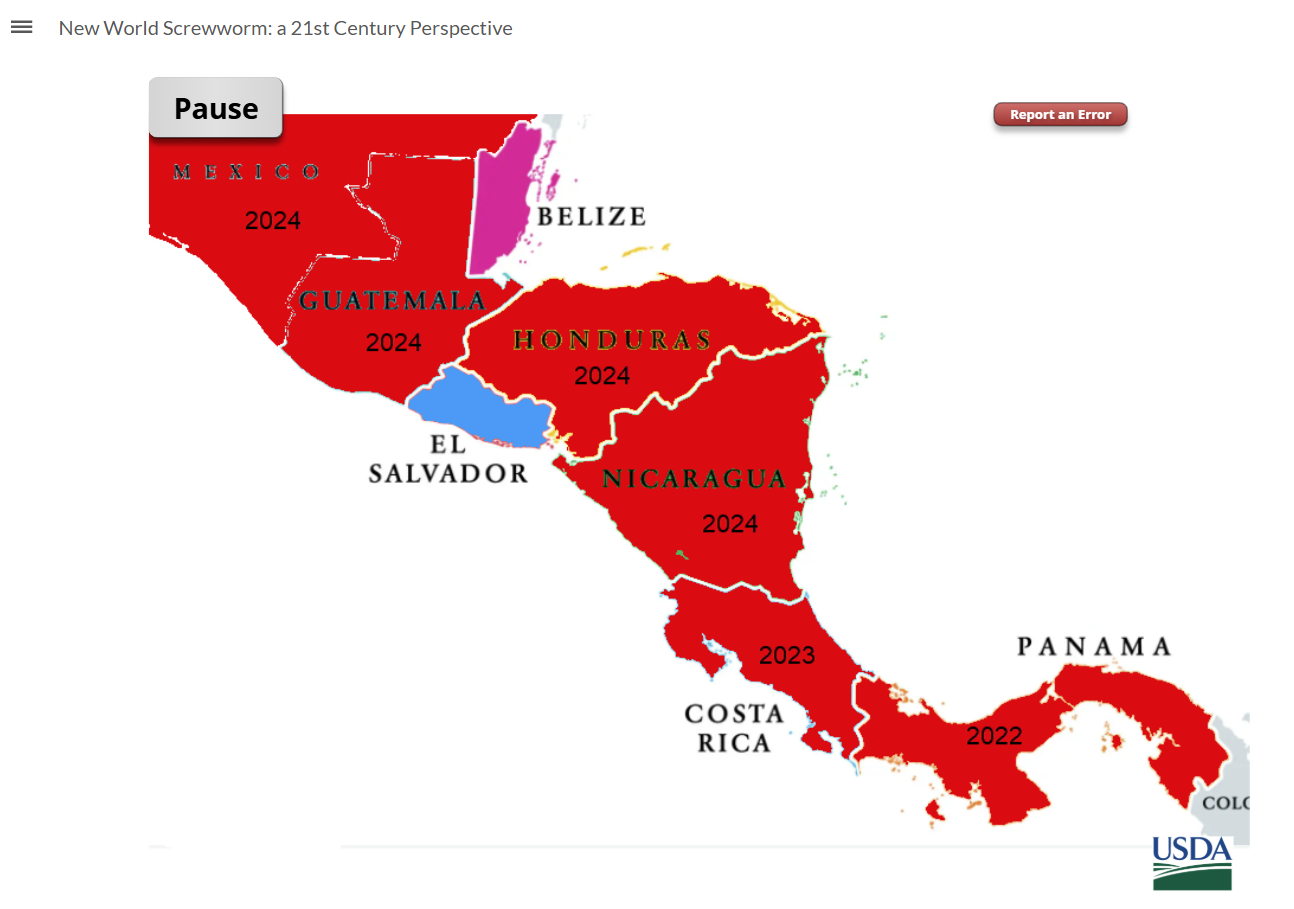
The ultimate goal of managing this parasite is to prevent the fly from crossing into Panama. Between Panama and Colombia lies a natural barrier known as the Darién Gap. This graphic illustrates the progression of the current infestation, beginning in Panama in 2022.
Several factors have been cited as contributing to the parasite’s northward spread. Reductions in funding for monitoring and containment programs limited resources available for surveillance and control efforts. In addition, budget cuts in 2012 resulted in the closure of a Sterile Insect Technique production facility in Mexico, increasing reliance on the remaining facility in Panama.
Staffing reductions within USDA agencies, including APHIS (Animal and Plant Health Inspection Service), have also raised concerns about response capacity and surveillance capabilities as new infestations emerged in Texas.
When this veterinary educational module was developed late last year, New World screwworm had not yet been detected in the United States. As of this writing, there are now 136 confirmed cases. Two of those cases have been documented in wildlife, while the remaining 134 have occurred in domesticated animals.
I have been trying to educate people on Facebook through my various horse- and dog-related groups. Most people have been eager for information, but there are always the usual naysayers.
Some people refuse to acknowledge that the fly is now present in the United States. Others understand that wounds are a primary point of entry for screwworm infestation, yet they either believe their animals will never be injured or assume that their animals will somehow avoid infection.
Still others view this as just another way for the government to exert influence over our personal autonomy, or they accuse veterinarians of hyping it up for money.
But here’s the thing… The flies are already in the United States.
And infestation does not always occur because of a wound. These flies are attracted to mucocutaneous junctions such as the eyes, lips, prepuce, vaginal area, navel, and other moist, accessible parts of the body.
I live in dusty Arizona and practice veterinary medicine through telehealth. Every day, I see animals with allergies that cause runny eyes, crusty skin, and other compromises to the body’s natural protective barriers. I see older dogs that are incontinent and have chronically moist, irritated vulvar areas that are further aggravated by licking. These are exactly the kinds of situations that can create opportunities for infestation.
Nearly four years ago, I wrote a blog post titled What Is Your Risk Tolerance? In that article, I quoted a resource that identified three components involved in a person’s willingness and ability to assess a potential risk and decide how to respond to it.
Risk Tolerance: What decisions will I make about whether to accept the risk, modify my behavior, or avoid the activity altogether? Do I accept or reject the risk?
Hazard Identification: Do I recognize that I am engaging in something risky? Am I in a situation where hazards are present? Do I see it?
Risk Perception: Am I processing how that risk could affect my well-being or the well-being of my animals? Do I understand it?
I have a neighbor who has several feral donkeys. One of them has a weeping, inflamed lesion on his leg. She can’t catch the donkeys, much less treat them.
I did my best to impress upon her the importance of addressing the problem. We are perilously close to the infected zones, and I believe it is only a matter of time before our area becomes one as well.
Despite my efforts, she canceled the veterinary appointment that could have at least improved the donkey’s condition. If that donkey attracts New World screwworm flies, he won’t be the only one affected. He will have some very unhappy neighbors.
The saddest part is this: if he becomes infested and remains untreated, he will likely die.
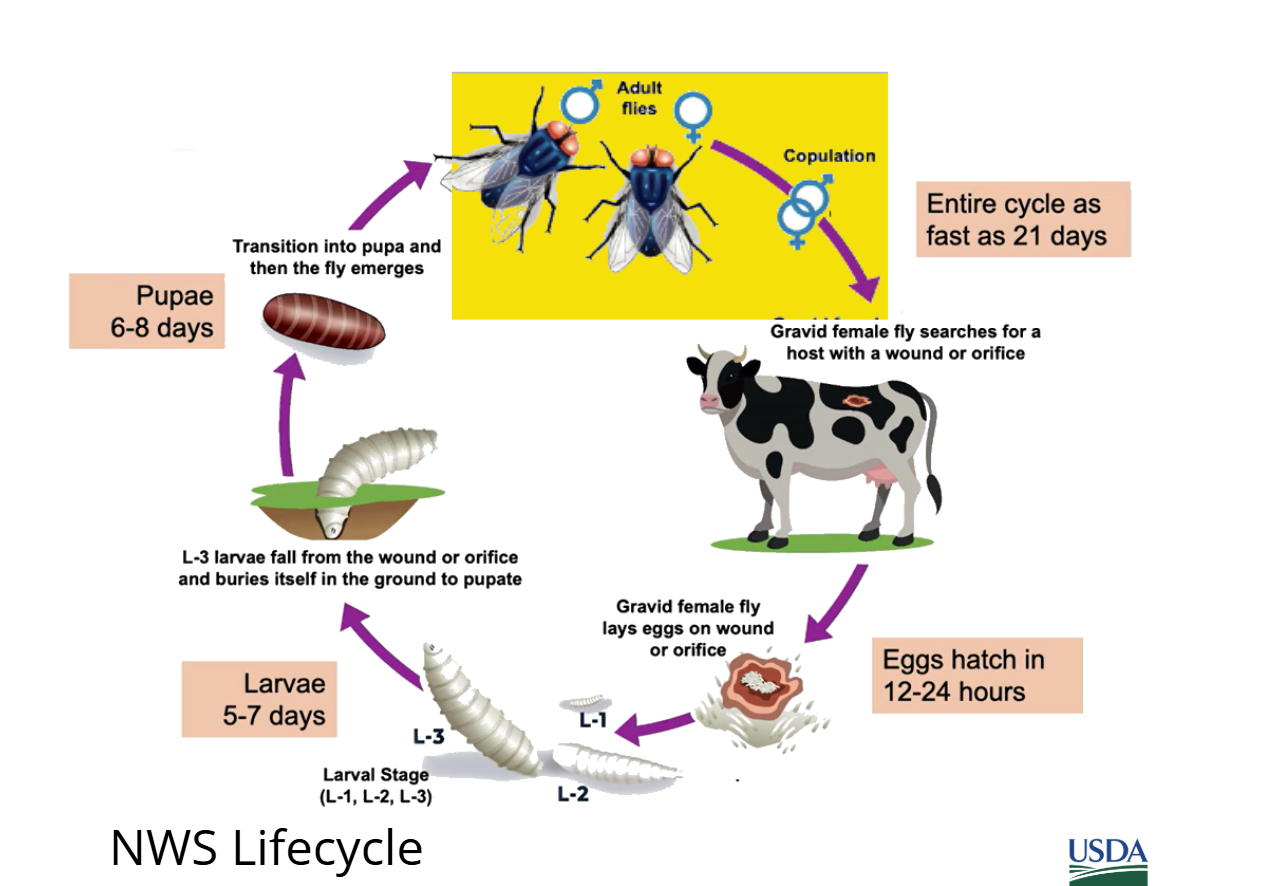
The lifecycle of the New World screwworm
Under optimal conditions, the life cycle of the New World screwworm fly can be completed in as little as 21 days. The good news is that we are heading into winter. Screwworm pupae cannot survive when temperatures drop below 46°F.
The single most effective method for eradicating this pest is the Sterile Insect Technique, which I mentioned earlier. Currently, two facilities are producing sterile male flies, and a third facility is being developed in Texas. However, the Texas facility is not expected to become operational until April 2027.
The process involves exposing New World screwworm pupae to gamma radiation. As a result, the male flies emerge sterile. Female screwworm flies typically mate only once before laying their eggs, while males mate repeatedly. Over time, as increasing numbers of sterile males are released into the environment, more females mate without producing viable offspring. Eventually, the population declines and can be eliminated.
What do I watch for?
This is a nasty parasite. It is imperative that you thoroughly examine your animals every day.
Recently, I found a very small scraped area on the underside of one of our horses. She likely acquired it from some of our less-than-friendly desert vegetation. If I hadn’t been actively looking for it, I never would have found it.
As I mentioned previously, you are not just looking for wounds. Any moist, irritated, or inflamed area can be at risk. Runny eyes, skin folds, the navel, irritated genital areas, and other sites where moisture accumulates can all attract these flies.
Forgive me, but I’m about to show you some photos that will definitely get your attention…
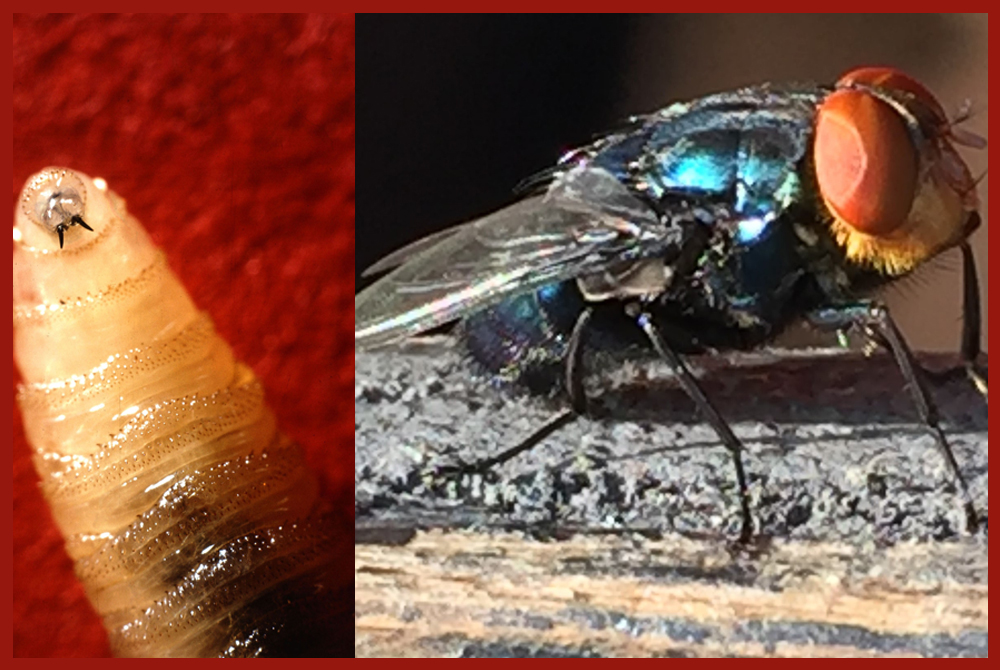
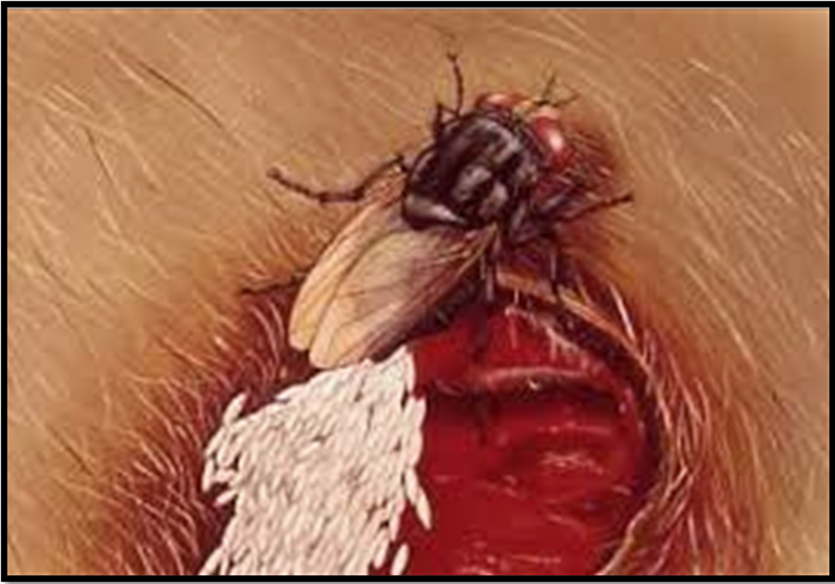
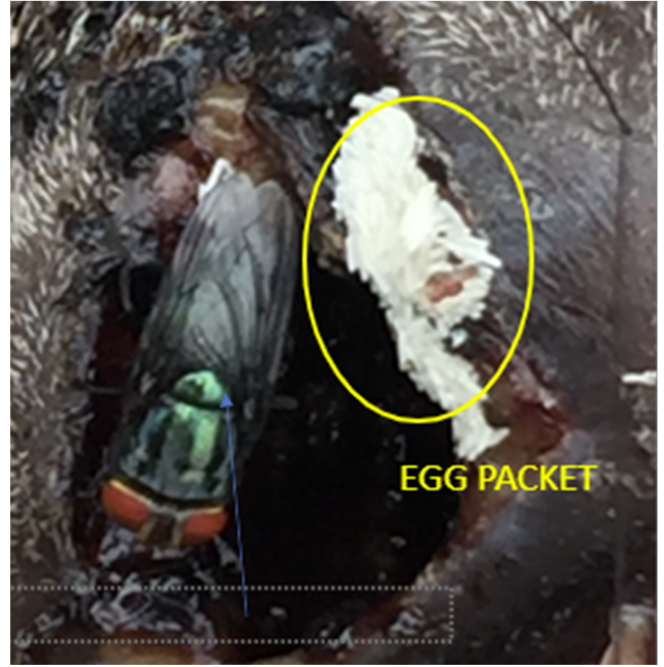
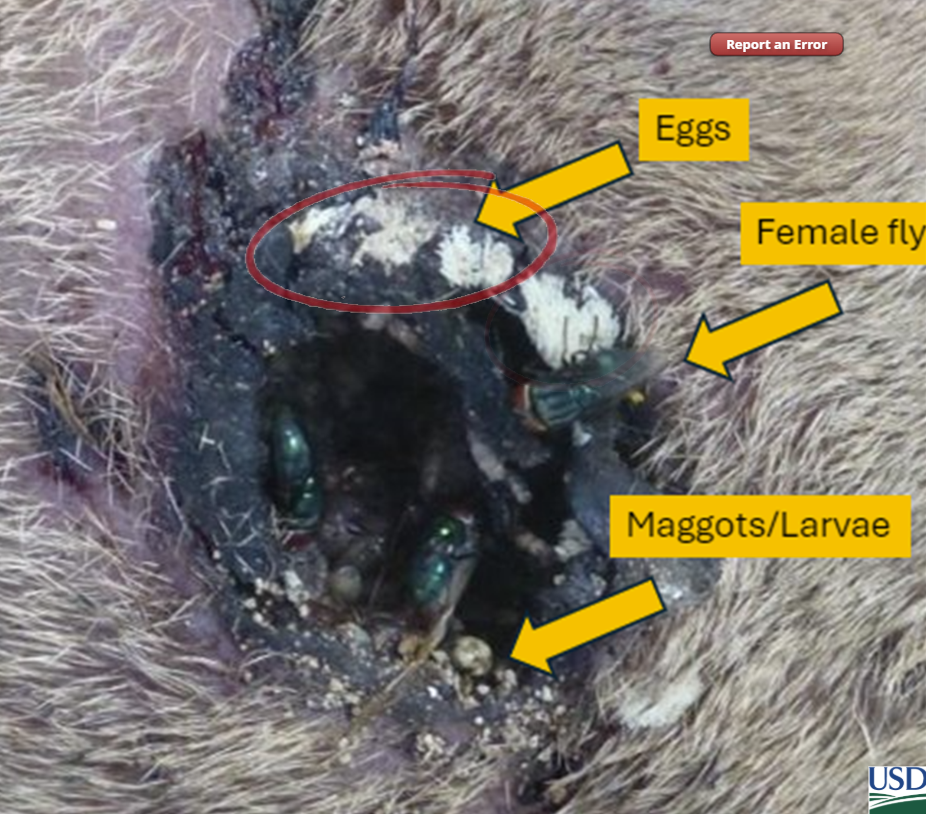
This is what New World screwworm eggs look like. They are often compared to shingles on a roof because of the way they overlap. On a long-haired or light-colored animal, they can be difficult to spot.
The photo on the right shows all three stages of the New World screwworm life cycle. In many cases, it may take two to three days before an owner notices an infestation.
The adult New World screwworm fly is about the size of a common housefly or slightly larger, with a metallic blue-green body, large orange-red eyes, and three dark stripes on its back.
Animals infested with New World screwworm may exhibit one or more of the following clinical signs:
Depression or lethargy
Loss of appetite
Self-isolation from the herd or other animals
Excessive rubbing against trees, fences, or other objects
Persistent licking or chewing at a wound or irritated area
Standing in water for prolonged periods
These signs are not specific to New World screwworm infestation, but they should prompt a thorough examination of the animal, especially in areas where screwworm has been confirmed.
What conditions put my dog or cat at greater risk?
As I mentioned, New World screwworms are attracted to wounds as small as a tick bite and can also invade mucous membranes. Dogs and cats at higher risk of infestation include those that:
Spend significant time outside
Have skin folds, long hair, allergies, or other medical conditions such as urinary incontinence
Are recovering from surgery or have recently given birth
Are already infested with mites, fleas, or ticks
Have significant dental disease
Have chronically tearing eyes or chronic ear infections
What can I do to prevent or treat NWS?
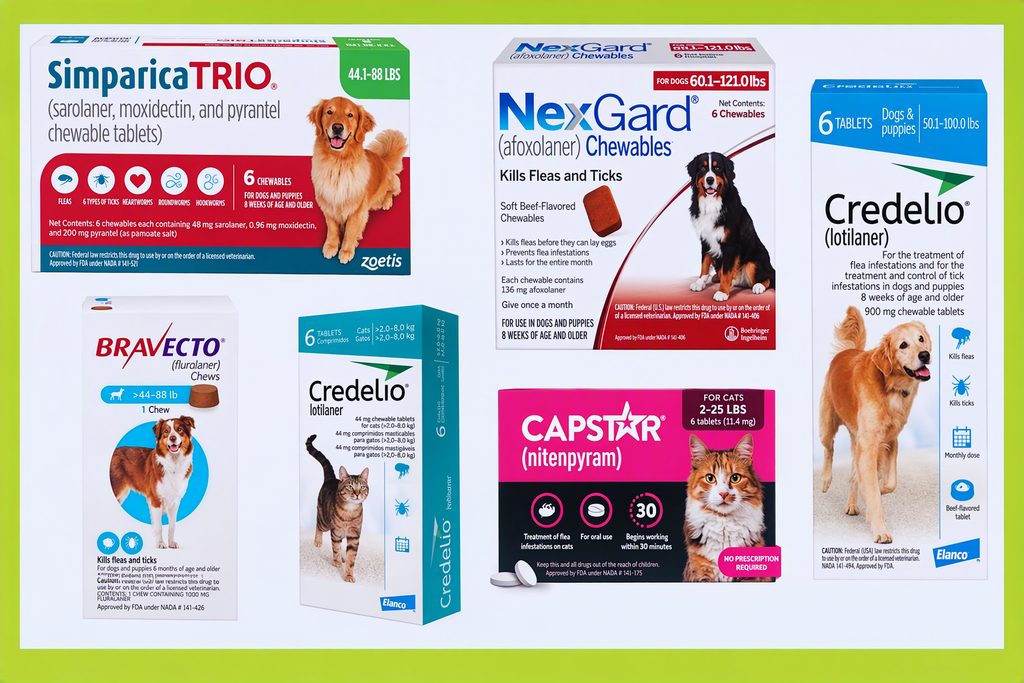
Isoxazoline flea and tick preventatives are the first line of defense against New World Screwworm (NWS) larvae in dogs and cats. There are two benefits to having your dog and/or cat on an oral preventative.
First, they kill any fleas or ticks that bite your pet. Keeping your pet flea- and tick-free prevents flea-bite dermatitis. Your dog or cat won’t scratch at itchy, bothersome parasites and cause skin damage that attracts NWS.
Second, while these products won’t prevent a NWS female from laying eggs on your pet, they will kill the larvae when they start to feed. The severe damage caused by NWS larvae results from their screw-like burrowing into the skin. If they die when they start to feed, that damage is minimized.
How does this infestation affect my travel plans?
Besides concerns about the health and well-being of their animals, this is the second most common question I receive.
Here’s the bottom-line answer: it depends on your state, your destination, whether your animals are located within an infected zone, and the species you plan to transport.
This website is your best friend: Simply enter your state of origin, destination state, and the type of animal you are traveling with. The system will generate the current movement requirements for your specific situation.
In some cases, the results will also include additional links, testing requirements, inspection requirements, health certificate information, or other state-specific regulations that must be met before travel. At this point, to my knowledge, having your pet on an Isoxazoline preventative is not required for interstate or intrastate movement, but it is strongly recommended by veterinarians and public health officials.
This PDF is targeted at veterinarians, but it has helpful information about what happens if an animal is diagnosed with a New World screwworm infection.
This is not a ploy for veterinarians to make extra money writing health certificates. It is at least as inconvenient for your already-overwhelmed veterinarian as it is for you. This is not fear-mongering or hype. It is very similar to what is happening in our country with measles—when things get out of hand, we all suffer. While this can impact people, it is rare. It is our animals that will suffer.
For those of you who don’t believe, please acknowledge that most of us simply want to stay ahead of this. For those of you seeking answers and trying to follow the rules, thank you. I appreciate you not only as a veterinarian, but also as a neighbor who is counting on you to do your part.





This was a very well-written and informative article on the NWS. Thank-you for posting this. I will share this.